
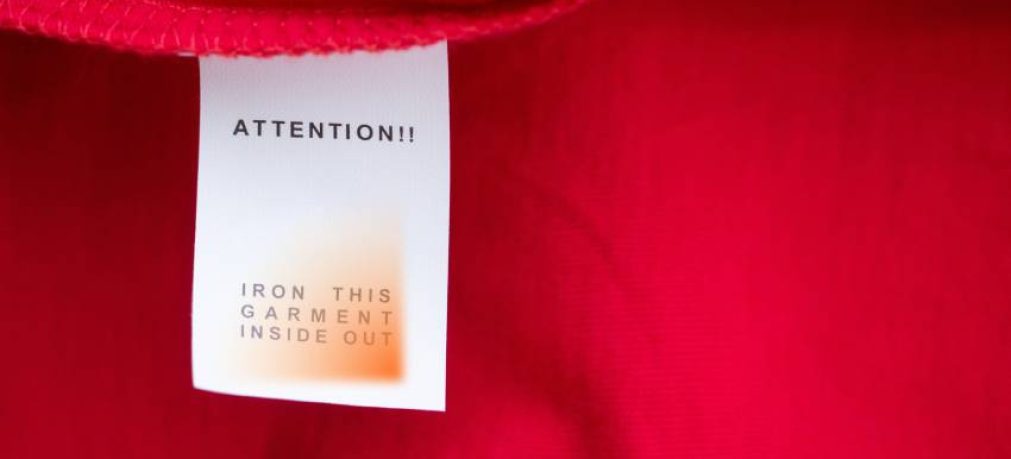
There is a silent problem in the fashion industry that repeats itself thousands of times every day: a well-made garment, crafted from quality materials, that reaches the consumer damaged because it was washed at the wrong temperature. Or that ends up returned, or discarded before its time, because the care instructions were not sufficiently clear. It is not a problem with the fabric’s quality — it is a problem of communication.
And this is where colour-changing labels have something interesting to offer, beyond the visual effect.
The most ignored care label in the world
Let us be honest: the washing instruction label is probably the least-read element of any garment. Small, awkward, covered in symbols that often require a manual to decipher. According to data published by AEG as part of the Care Label Project, 90% of clothing is discarded far sooner than necessary, and up to 70% of those cases are down to avoidable damage — such as fading, shrinkage, or distortion caused by incorrect care. It is not the fabric that fails; it is the washing.
For a manufacturer, that has very direct consequences: complaints, after-sales management, and reputational damage for a product that was technically sound but reached the consumer in poor condition due to something that happened in their home, not in your factory.
Thermochromic labels — those that change colour in response to temperature — offer a different answer to this problem. Not a static instruction the consumer can ignore, but a visual signal that acts at specific moments and for well-defined purposes.
Reversible and irreversible: a distinction that changes everything
Before discussing specific applications, there is a technical difference worth understanding, because it entirely determines what each type of label is useful for.
Reversible inks change colour upon reaching a given temperature and return to their original state once the stimulus ceases. They are the best-known type and the ones with a genuinely preventive use: the change occurs while the problem is happening, so the user can still do something about it.
Irreversible inks change once and stay that way. They do not prevent damage, but they record that it occurred. Their value is diagnostic: they tell you what happened, not how to stop it.
This distinction determines when a label of this kind has real practical value and when it promises more than it can deliver.
What can such a label actually do?
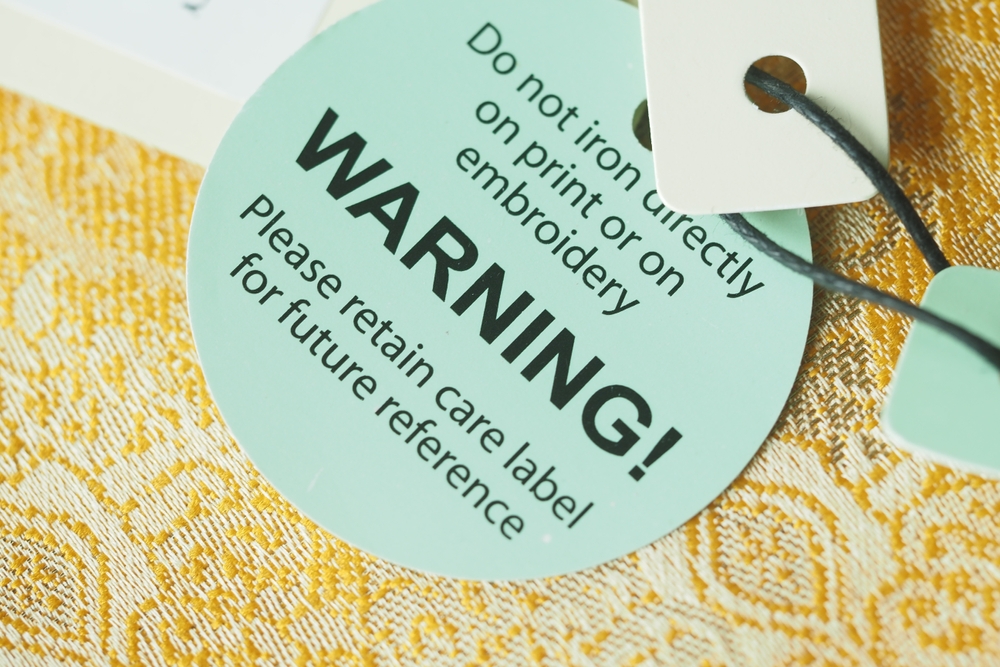
Warning before ironing (reversible). This is the clearest use case and the most genuinely preventive. A reversible label in the area that will receive heat changes colour when the iron exceeds the recommended temperature for that fabric, before the damage occurs. Unlike washing, ironing is slow and entirely in the user’s hands at every moment: they see the signal and can stop. Here, the label delivers exactly what it promises.
Knowing what went wrong: recording exposure to excessive heat (irreversible). If a garment was washed or tumble-dried at the wrong temperature, the label records it permanently. It does not prevent the damage, but it resolves something that is currently very difficult to prove: whether the deterioration of a garment stems from a manufacturing defect or from incorrect care. For a manufacturer, that is enormously valuable when handling a complaint. The label acts as an objective witness in a conversation that today is typically resolved in the consumer’s favour, whether or not they are in the right.
Authentication and anti-counterfeiting (reversible). The colour change of these inks is difficult to replicate without access to the original formulation, making them a straightforward and visual anti-counterfeiting tool. A label that only reveals a symbol or pattern when body heat or friction is applied is something the consumer can verify on the spot, without any device. It is particularly useful in mid-to-high-end fashion or in garments with certifications relating to materials or production processes.
Quality control in industrial laundry and workwear (irreversible). In hospital clothing, uniforms, or any garment with strict hygiene requirements, an irreversible label can confirm that the garment reached the washing temperature necessary for proper sanitisation. Here the application is the reverse of the above: it is not about detecting excess temperature but about verifying that the required minimum was reached. A practical use in sectors such as healthcare, hospitality, and food production.
Temperature chain indicator in storage and transport (irreversible). Before a garment reaches the customer, it may have passed through uncontrolled warehouses or transit in the height of summer. An irreversible label records whether there was exposure to unsuitable temperatures and makes it visible at the point of receipt. Useful for internal quality control and also for having solid grounds when an issue arises with a distributor or carrier.
Product differentiation in technical garments (reversible). In performance clothing, an active label reinforces the message that the garment requires a different kind of care and that the manufacturer has taken that seriously. It is not a functional indicator in the strict sense, but it is a value proposition that resonates well with the consumer of sportswear or technical apparel, and one that the brand can weave into its product story.
Why it makes sense to consider this now
London-based design studio The Unseen has spent more than a decade exploring the possibilities of thermochromic inks in fashion: pieces that change colour in response to heat, friction, or environmental conditions. Their work has demonstrated the expressive and functional potential of these technologies.
But that is changing. Formulations are more durable and more affordable than they were a few years ago, and the market is asking for precisely what these labels can offer: products that last longer, that are easier to care for, and that carry a genuine sustainability argument.
Moreover, according to WRAP UK data, extending the life of a garment by as little as nine months can reduce its carbon footprint, water consumption, and waste generation by between 20 and 30%. If a label contributes to that, even in specific use cases, the story holds up on its own.
The care label has spent decades being the most ignored element of a garment. Thermochromic inks give it an active function, without asking anything of the consumer beyond noticing what they see.
The key lies in choosing wisely: a reversible label where the user can still react (ironing is the clearest example), an irreversible label where what matters is leaving a record of what occurred (complaints, industrial hygiene, traceability in the distribution chain).
For a manufacturer, the advantages are tangible in both cases: less strain on after-sales management, stronger product arguments, and a tool that fits well with what the market is asking for. And, at its core, yet another example of how a label can offer far more than just information.