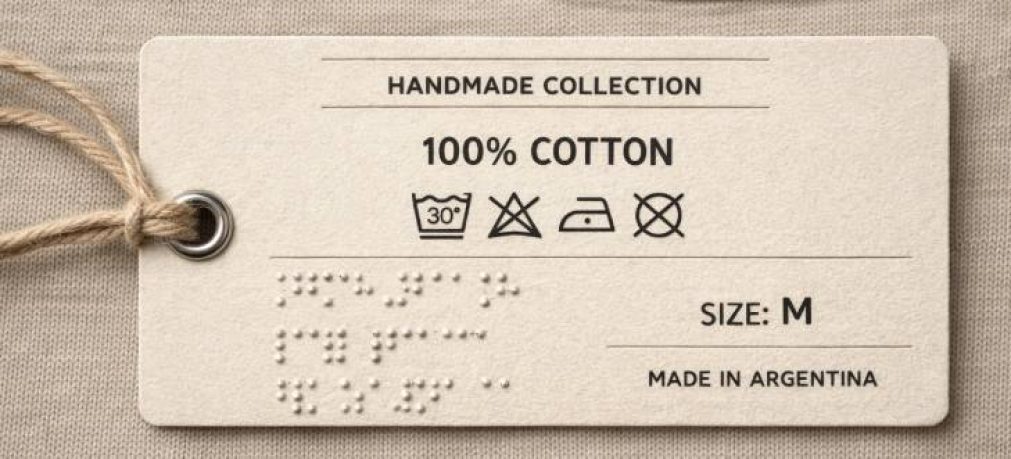
A garment’s label contains crucial information: size, composition, care instructions… But what if you can’t see it? For millions of people with visual impairments, that information remains a mystery, because most labels are designed solely with those who can see in mind. It’s not necessarily ill-intentioned—it’s the legacy of traditional labelling. But today, there are no excuses: fashion can be accessible too.
The challenge is clear: how can we ensure essential information reaches everyone without compromising style or brand identity? Designing accessible labels is not just an inclusive gesture; it’s an opportunity to strengthen relationships with diverse customers and prepare your brand to comply with current and upcoming regulations.
What are accessible labels?
Accessible labels are labels that, when designed, include solutions that allow people with visual impairments to identify and understand product information by means other than sight. Some options include:
- Braille for tactile reading.
- Raised or tactile QR codes that link to accessible content on a mobile device.
- NFC technology or voice-activated features.
- Tactile markers that help locate the accessible information.
The goal is for anyone to be able to access essential details—garment name, size, composition, care instructions—without relying on someone else’s sight.
Ideas for implementing accessible labels
1. Tactile Braille
This is the most common method: it involves incorporating Braille characters and tactile markers to indicate basic information such as size, garment name, and composition.
When implementing it, the dimensions and spacing of the Braille must be respected to ensure legibility, and an icon or tactile mark should be included to help locate the Braille.
This approach is already being promoted in Spain: new regulations require Braille and tactile systems for basic information on consumer products.
2. Accessible QR codes with enlarged text and audio
These are QR codes designed to be detectable by touch and, when scanned, provide information in accessible formats: large text, audio, multiple languages.
How to implement:
- Print the QR code with a tactile or raised frame.
- Ensure the website it links to meets accessibility standards (WCAG) and works with screen readers.
Visual tip: Label the QR code in relief with the phrase “Scan for accessibility” in Braille and raised lettering.
There are already solutions that combine accessible QR codes with voice reading and multilingual support.
3. NFC and smartphone technologies
These are discreet NFC chips embedded in the label that allow users to access accessible content—large text, audio, or sign language videos—by bringing a smartphone close.
It is necessary to integrate the NFC antenna into the label or packaging and link it to a platform with fully accessible content.
By combining tactile and digital solutions, this system is perfect for providing information beyond the physical label.
Best practices that work (and respect your visual identity)
- Define the essential information that must be accessible: size, composition, care instructions, country of origin, usage guidelines.
- Combine formats: Braille for tactile access, QR codes for extended details, tactile markers to help locate the label.
- Align with production processes: incorporate accessible solutions from the garment design stage, rather than as an afterthought.
- Test with real users: accessibility is not just about meeting regulations; it should be verified with people who actually use these solutions.
These practices allow accessibility to be integrated elegantly, efficiently, and consistently with your brand image.
Inclusion that adds value
Making labels accessible is not just about complying with regulations; it’s about providing a richer and more consistent experience for all customers. Brands that incorporate Braille, accessible QR codes, or NFC not only demonstrate social commitment but also strengthen their image and get ahead in a more diverse and demanding market. Inclusive fashion is possible—and it starts with the smallest detail: a label everyone can read.